FAQs — Diving Beyond MS
This is not medical advice. Please talk to your entire team before diving — your neurologist, DAN (Divers Alert Network), and the dive shop or instructor you're working with. Everyone's MS is different, and so is everyone's dive plan.
Medical and Safety
Can I dive if I have MS?
Possibly! MS affects everyone differently, so there's no blanket rule — but a lot of people with MS dive safely, including me. It comes down to your specific symptoms, your neurologist's input, and the right precautions.
Do I need medical clearance before taking a scuba diving course?
Before registering or paying for a course, review the standard Diver Medical Participant Questionnaire. If you answer “YES” to any of the initial screening questions, you may need to have a physician complete the Physician’s Evaluation Form before you can get in the water. We recommend checking the questionnaire before booking your course so you have enough time to speak with your doctor if needed.
Can I dive during or right after a relapse?
No. This one's not a judgment call — during an active relapse, your symptoms and your baseline are both unpredictable, which is exactly the combination you don't want underwater. Wait until you're cleared by your neurologist and back to your stable baseline, not just "feeling better today."
What if I don't feel well on dive day?
Any diver can cancel any dive at any time, for any reason, without getting any shit from other divers. MS doesn't run on a schedule, and neither do we. Your body gets the final vote, always.
Questions about specific medications, infusion timing, or heat/cold sensitivity? That's exactly what our neurologist checklist is for — [get the checklist].
Physical and Mobility
I use a wheelchair or have limited mobility — can I still dive?
Yes. The water doesn't care what your legs do on land. Adaptive diving exists specifically for this — different gear, different techniques, same ocean.
My MS is invisible — does this still apply to me?
Yes. "Adaptive diving" isn't just for visible mobility differences. Fatigue, numbness, heat sensitivity, balance issues, cognitive fog — all of that counts, even if nobody looking at you would guess. You don't need a visible disability to need an adapted plan.
What if I don't have full leg function or sensation in my hands/feet?
You don't need working legs to move through water — there are adaptive propulsion techniques and equipment for that. Reduced sensation just means adapting: different buddy signals, more reliance on sight instead of touch. Neither is the bar for diving.
What adaptive equipment is available?
Depends on your needs — modified BCDs, alternate propulsion devices, specialized fins or no fins at all, tools for buddy communication when verbal or hand signals are hard. Equipment should match you, not the other way around.
Getting Started
Do I need dive experience or to already know how to swim?
No prior dive experience needed — most people start with zero. Some baseline water comfort is part of standard certification, usually shown through a swim test, but that test can often be adapted to fit your body. Talk to an adaptive-certified instructor about what that looks like for you.
What certification do I need?
There are adaptive certification tracks through agencies like PADI, NAUI, SSI, and HSA (Handicapped Scuba Association) built specifically for divers with disabilities. Certifying divers isn't something we do — that's what those agencies and instructors are for. We've put together a checklist of questions to bring to a dive shop to help you figure out if they're actually equipped for adaptive training.
Do I go straight into the ocean on my first dive?
No. Training starts in a pool or confined water, where you build skills and muscle memory before open water is ever on the table. Adaptive-certified instructors work through that progression at your pace, not a fixed timeline.
What if my neurologist says no?
Then you don't dive — full stop. But "no" isn't always permanent; sometimes it's "no, not with your current symptoms." Our neurologist checklist can help you ask what specifically concerns them, so you know what to revisit later. Have a question we didn't cover — age limits, gear ownership, insurance? [Reach out] and ask us directly.
Have a question we didn't cover — age limits, gear ownership, insurance? [Reach out] and ask us directly.
What if...?
I'm scared of the water, or scared of my own body failing underwater. Is that normal?
Extremely normal. Most people are scared before their first dive, MS or not. Being scared is expected, not a red flag.
Will I feel like a burden to the people I dive with?
Honestly? Probably, at first. That feeling doesn't mean you're right — it means you're new to needing support. Diving is a buddy sport by nature — nobody dives alone, MS or not. The more you do it, the more you realize the dive community isn't tolerating you — they want you in the water.
What if I need to call the dive once I'm already in the water — or I have a panic moment and can't tell if it's MS or fear?
Any diver can end a dive at any point, for any reason — that's not an MS rule, that's a diving rule. Signal a thumbs up, turn the dive around, it's over. And if you're not sure whether what you're feeling is panic or a symptom — you don't have to diagnose it mid-dive. The move is the same either way: stop, signal, breathe, ascend if needed. Pool and confined-water training build that response into muscle memory before it ever matters in open water.
What if a dive shop turns me away?
It happens, and it's not a reflection of whether you're capable — it's usually a reflection of that shop not having the training or gear yet. Don't let one shop convince you it's a universal no. Our dive shop checklist can help you vet the next one, or reach out and we'll try to point you somewhere good.
Ready to Dive In?
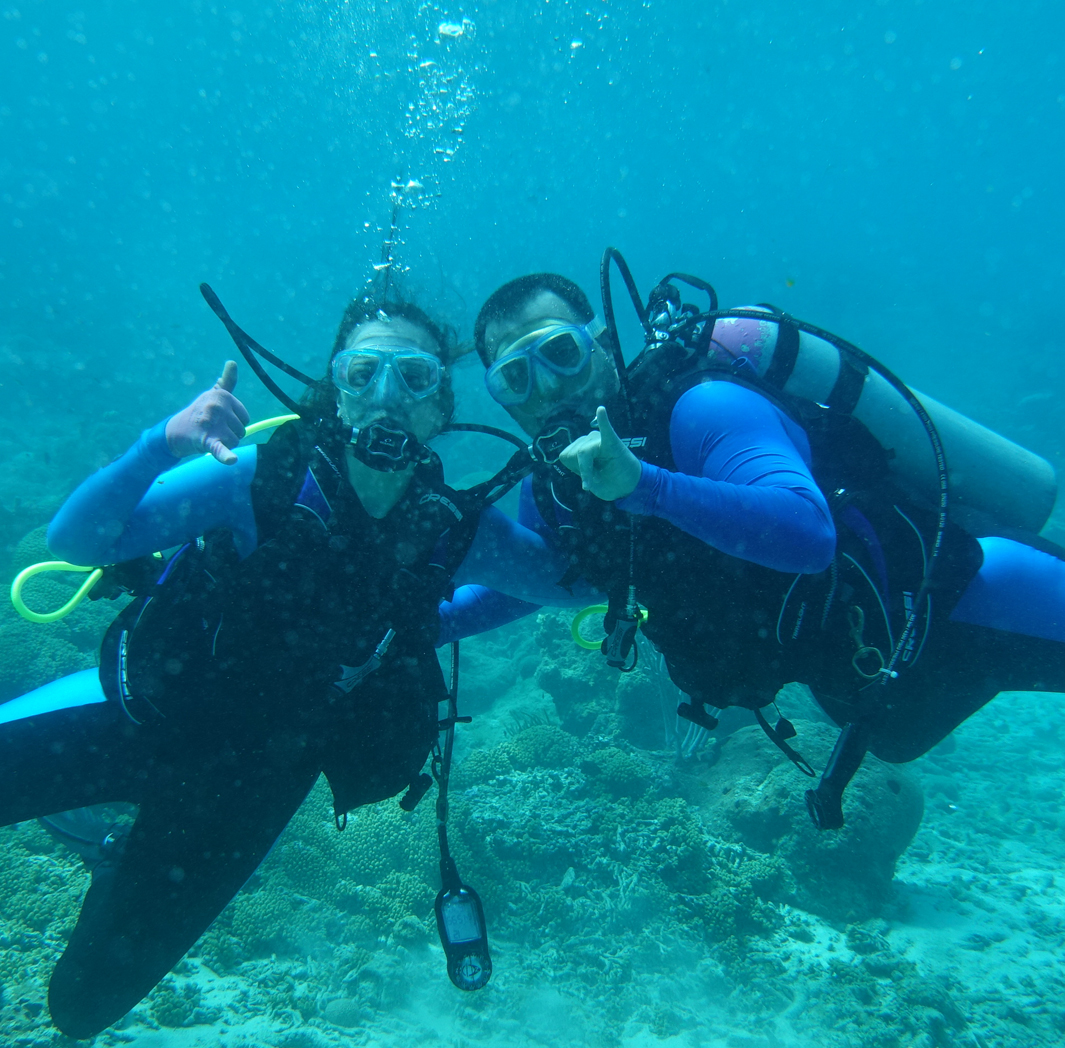
DM us on Instagram @diving_beyond_ms — that's the fastest way to reach Adri and Bruce directly, whether you're a diver with questions, an instructor who wants to get involved, or a dive shop looking to partner.
After reading through all of these FAQs, what do you think? Ready to give diving a try? Reach out with any more questions — we'd genuinely love to hear from you!
Give us a follow on Instagram: @diving_beyond_ms
Don't forget to follow the mermaid's tail: @mymsmermaidlife on Instagram, Facebook, and TikTok!